RENDER TO CAESAR THE THINGS THAT ARE CAESAR’S AND TO GOD THE THINGS THAT ARE GOD’S MATTHEW 22:21

INTRODUCTION

Well, it is time for another election here in the United States.  Some people flip a coin…some people vote their tribe…many agonize to the point of staying home.  Many faithful Catholics will suffer as they joust their consciences with their “self-interest.” As disciples of Christ our self-interest should be our God interest.

 WHO FORMS YOUR CONSCIENCE, JESUS CHRIST OR A POLITICAL PARTY?

Is it your personal encounter with Jesus Christ and His Church or is it the ideology of some political party? A well-formed conscience is necessary to make correct moral decisions. Voting is a moral obligation because through it we seek to affirm the moral truths that shape our lives as Catholics in a secular world.

 “Conscience is a judgment of reason whereby the human person recognizes the moral quality of a concrete act that he is going to perform, is in the process of performing, or already has completed performing.  Conscience is a faculty of the intellect not the will.  Man has the right to act according to his conscience, in fact is required to do so, even if it might be mistaken.  However, born with a clouded intellect after the original fall, man is also required to educate his conscience to discern God’s will as revealed in Divine Law.” (CCC 1778)

 ELECTION ISSUES

Abortion is an intrinsic evil. It is intended to kill the innocent human being growing in the mother’s womb and is never permitted.  Abortion is not an acceptable means of birth control or a choice of the parents for a preferred gender or because a baby will be inconvenient. Nor is it acceptable to abort a child that may suffer from some disease or disability.  That is euthanasia of the unborn.

Human life is sacred. Direct attacks on innocent human beings are never morally acceptable. Within our society, life is under direct attack from abortion, euthanasia, human cloning, and destruction of human embryos for research. These intrinsic evils must always be opposed.

God chooses life but not just the life of the unborn but the life of the already born.  Jesus in his public ministry addressed the needs of the living by healing those from the effects of original sin, forgiving sins, healing the sick, raising the dead, preaching justice, and calling that we all be one like He and the Father are one.

Catholic Christians have been continually disappointed by politicians who say they are pro life when in fact they are more anti-abortion  than PRO LIFE ISSUES.  Pro Life is a seamless garment.  When these politicians get in office because of well-intentioned Christian votes, they consistently oppose the “common good.” They often seem to care very little for the needs of the already living human beings that Jesus addressed in His public ministry.

WHAT IS THE “COMMON GOOD”

 CATECHISM OF THE CATHOLIC CHURCH 1906-1909

“the sum total of social conditions which allow people to reach their fulfillment more fully and more easily.”….public authorities are bound to respect the fundamental and inalienable rights of the human person…the right to act according to a sound norm of conscience,  safeguard privacy, freedom in matters of religion.”…and the stability and security of a just order.

 US CATHOLIC BISHOPS GUIDELINES FOR VOTERS

A consistent ethic of life should guide all Catholic engagement in political life. Catholics should commit to defend human life and other human rights, from conception until natural death, to respect the dignity of every human being as a child of God.

We focus on the “common good” We ask how we can make the world a better place; not how I can improve my personal situation.  Other assaults on human life and dignity, such as genocide, torture, racism, the targeting of noncombatants can never be justified. Disrespect for any human life diminishes respect for all human life. As Catholics we are not single-issue voters.

 Caring for God’s Creation Care for the earth is a duty of our Catholic faith. We all are called to be careful stewards of God’s creation and to ensure a safe and hospitable environment for vulnerable human beings now and in the future

Option for the Poor and Vulnerable While the common good embraces all, those who are in greatest need deserve preferential concern. A moral test for society is how we treat the weakest among us—the unborn, those dealing with disabilities or terminal illness, the poor and marginalized, The Federal budget is a moral document and must provide as well for the poorest and most vulnerable in society.

 Dignity of Work and the Rights of Workers The economy must serve people, not the other way around. Economic justice calls for decent work at fair, living wages, opportunities for legal status for immigrant workers, and the opportunity for all people to work together for the common good through their work, ownership, enterprise, participation in unions and other forms of economic activities.

Immigration needs be addressed in a humane way with compassion, while securing and protecting our borders.  We must welcome the foreigner in search of the security and the means of livelihood which he cannot find in his country of origin out of charity and respect for the human person. We have the right and duty to secure one’s border and enforce the law for the sake of the common good. Sovereign nations have the right to enforce their laws and all persons must respect the legitimate exercise of this right.

CONCLUSION

We must be the leaven in society that bears witness to the Truth and bring others into God’s reign on earth.  If you truly live your Catholic faith, you may not find complete alignment with any political party.   Pray and Trust in Jesus that the vote you cast is the best vote you can cast.

Let us continue to pray for one another in our discernment process and forming a conscience according to God’s will as revealed in Divine Law.

Let us call on the Holy Spirit in our discernment as we prepare to perform not only our civic duty but our moral duty.

Come Holy Spirit,

fill the hearts of your faithful,

kindle in them the fire of your love.

Send forth your Spirit and they shall be created.

And you shall renew the face of the earth.

O, God, who by the light of the Holy Spirit,

did instruct the hearts of the faithful,

grant that by the same Holy Spirit

we may be truly wise

and ever enjoy His consolations,

Through Christ Our Lord, Amen.

 VISIT stillromancatholicafteralltheseyears.com FOR PAST POSTS AND TO SUBSCRIBE TCB
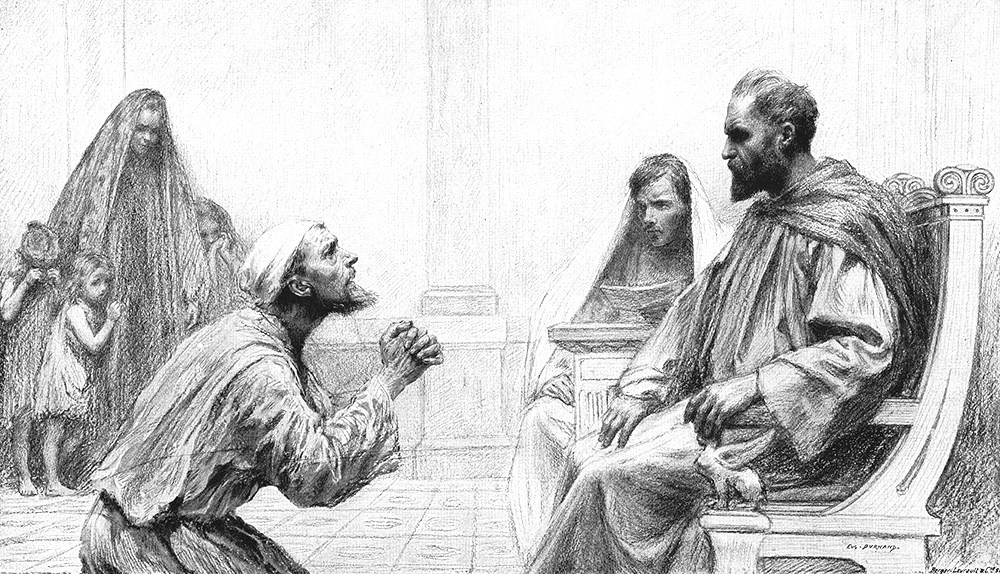
JESUS IN SCRIPTURE PARABLE OF UNFORGIVING SERVANT


MATTHEW 18:23-35 PARABLE OF UNFORGIVING SERVANT

Peter asked Jesus, “Lord, if my brother sins against me, how often must I forgive him?  As many as seven times?” Jesus answered, “I say to you, not seven times but seventy-seven times.

That is why the kingdom of heaven may be likened to a king who decided to settle accounts with his servants. When he began the accounting, a debtor was brought before him who owed him a huge amount.

Since he had no way of paying it back, his master ordered him to be sold, along with his wife, his children, and all his property, in payment of the debt.  At that, the servant fell down, did him homage, and said, ‘Be patient with me, and I will pay you back in full.’  Moved with compassion the master of that servant let him go and forgave him the loan.

When that servant had left, he found one of his fellow servants who owed him a much smaller amount.  He seized him and started to choke him, demanding, ‘Pay back what you owe.’  Falling to his knees, his fellow servant begged him, ‘Be patient with me, and I will pay you back.” But he refused. Instead, he had him put in prison until he paid back the debt.  Now when his fellow servants saw what had happened, they were deeply disturbed, and went to their master and reported the whole affair.

His master summoned the (unforgiving) servant and said to him, ‘You wicked servant! I forgave you your entire debt because you begged me to. Should you not have had pity on your fellow servant, as I had pity on you?’  Then in anger his master handed him over to the torturers until he should pay back the whole debt. So will my heavenly Father do to you, unless each of you forgives his brother from his heart.

 REFLECTION:

Peter asks a reasonable question, ”How often must I forgive my brother…”  it is difficult to forgive after all….sometimes we can’t forgive ourselves….we must accept and trust in the mercy of God…there is no sin so bad or so big that God’s mercy can’t wipe clean….in this parable Jesus addresses our forgiving others…Forgive us our trespasses as we forgive those who trespass against us….be careful of what we pray for….the measure we measure will be measured to us…we are told to be perfect as our heavenly Father is perfect…one way we achieve this is through forgiving others…we live now in time of mercy…later there will be judgment…so will my heavenly Father do to you as you do to others…

SILENT PRAYER

PLEASE VISIT stillromancatholicafteralltheseyears.com FOR PAST POSTS AND TO SUBSCRIBE TCB

BLESSED VIRGIN MARY, MODEL OF FAITH AND OBEDIENCE

October is one of two months of the year particularly dedicated by the Church to honor Mary.  It is the month of the Holy Rosary and also includes the last apparition at Fatima, the miracle of the Sun, October 13. It is good to ponder Mary’s role in Salvation History.

For our Protestant brethren, let me say right up front that the Catholic Church does not worship Mary or make her an idol.  We honor her as the Mother of God, Jesus.  It is Mary’s flesh that Jesus took on to share in our humanity.  All covenants failed until the New Covenant of Jesus.  Man could not save himself under the law.  Constantly man was breaking the law of the Covenant. It took a human and Divine human being to atone for our sins.

Mary did not just drop from the sky.  Her part in the salvation story had been predicted in the Old Testament book of Genesis, “I will put enmity between you and the woman, ,and between your offspring and hers; They will strike at your head, while you strike at their heel.

Genesis 3:15.

 In the Prophet Isaiah, a sign of the awaited Messiah is given, “The Lord himself will give you a sign, the young woman, pregnant and about to bear a son…Isaiah 7:14.  Even the place is predicted in Micah, “But you, Bethlehem-Ephrathaha least among the clans of Judah, from you shall come forth for me one who is to be ruler in IsraelMicah 5:2

Mary is foreshadowed in the person of Eve.  Both are mothers of all the living, yet in different ways. Eve is the mother of all those living with natural life, while Mary is the mother of all those living with supernatural life,

Without Mary, no Jesus, without Jesus, no salvation.  Some will say I don’t need Mary, I pray directly to Jesus.  Fine, but don’t we need all the help we can get.  Why not ask His mother to intercede on our behalf too.  After all Jesus performed His first miracle at His Mother’s request although His time had not come yet.

When we are having upcoming surgery we don’t just ask one friend to pray for us but we ask for all the prayers we can get.  Praying to Mary can’t hurt anything but can only help.

Mary is the model of faith and obedience.  At the Annunciation, Mary’s fiat, “let it be done to me according to your word…,” Luke 1:38 demonstrates her complete obedience to God and to His will for her. Church Father, St. Irenaeus, says, Mary “being obedient, became the cause of salvation for herself and for the whole human race.”

.The knot of Eve’s disobedience was untied by Mary’s obedience: what the virgin Eve bound through her disbelief, Mary loosened by her faith.  Our obedience of faith must be given to God as He reveals Himself, to us.  It involves a complete submission of one’s self to God’s will.

We must have a humble faith, which means that we recognize it as an unmerited gift from God.  Recall when Mary’s cousin Elizabeth greeted Mary as singular blessedness, “Most blessed are you among women, and blessed is the fruit of your womb.”

Mary immediately turned the attention away from herself to magnify the Lord. Mary’s hymn of praise, known as the Magnificat, is a shining example of the humble being exalted.

Mary’s perfect humility constantly leads her to point to her divine Son.  “My soul proclaims the greatness of the Lord; my spirit rejoices in God my savior. For he has looked upon his handmaid’s lowliness… Luke 1:46.

We, too, who have been baptized into eternal life must magnify the Lord through our very lives.   Like Mary, our “humble faith” must lead us to bear witness to the great things God has done for us. We must proclaim Christ at every opportunity in a way that invites others to “come and see.

In Luke 1:29 and Luke 2:19, Mary is pictured as a woman of faith who pondered all things, Jesus, in her heart.  Mary’s “recollected faith” teaches us the importance of listening to God’s word, pondering the truths of our faith, and praying daily that our faith be preserved and strengthened.

Faith is a gift that is received or revived at any given moment in history. Faith is also a virtue. Like a muscle, it will go flabby if it’s not exercised but it will also grow stronger if we actively strive to grow in holiness.

Mary advanced in her pilgrimage of faith, from the Annunciation to Calvary, then to Pentecost. Mary never ceased to “wonder” in awe all that faith had revealed to her.  Are we still awestruck in our faith at all that God has done for us or have we become indifferent and lukewarm?   Mary, now assumed into heaven, is no longer on a pilgrimage herself, but continues to be a beacon of light for those of us still on the journey home.

PLEASE VISIT stillromancatholicafteralltheseyears.com FOR PAST POSTS AND TO SUBSCRIBE TCB


THE MASS THE WORSHIP WE PAY GOD FOR ALL HE GIVES TO US

JESUS INSTITUTES THE EUCHARIST

INTRODUCTION

For some time now I have been wondering how I might help improve Sunday Mass attendance among my fellow catholics.  All surveys and polls show less and less each decade attend Sunday Mass on a regular basis despite objectively it is a grave sin to miss Mass on Sundays intentionally without sufficient cause.

Catholics must worship God on Sunday and Holy Days of Obligation by participating in the Holy Mass. I know we are in that era of “cafeteria Catholics” who pick and choose what teachings of Jesus and His Church they are going to follow.

When it comes to the Mass, one may hear comments like, “it is boring,”  “I don’t get anything out of it.”  Some will say, I can worship God by going for a walk and appreciating nature. First, I will address the idea of The Mass being boring and getting nothing out of it.  The Mass is primarily about worshipping God not about you getting some kind of thrill or high as you might with a material thing.

We were not at Calvary over 2000 years ago when God died for our sins in atonement.  But at every Mass we re-present that sacrifice in an un-bloody manner.  We receive again through no merit of our own all the graces that were merited by Jesus over 2000 years ago and participate in our redemption by offering ourselves to the extant we can.  So we do get something after all, an increase in sanctifying grace.

Just a word for the nature lover who chooses walks over attending Mass.  It is a good thing to acknowledge God the Creator but God is also the Redeemer, and Sanctifier.  The best way to give thanks (eucharistia) for all that God has done for us is the Liturgy of the Mass.

I am convinced if a person knew and understood the various parts of the Liturgy of the Mass Mass would no longer be boring or something to be skipped or set aside. Nowhere on earth will one be closer to Jesus than in the Liturgy of the Mass which includes the Eucharist, the source and summit of our faith.

So let’s begin:

 INTRODUCTORY RITES

 At Mass we are welcomed by the priest celebrant who stands in the place of Christ.  We begin with the sign of the cross placing ourselves in God’s presence and bearing witness that we are as a community pledged to Christ’s standards, not the world’s. Just as Jews in Israel, had to cleanse themselves before worshipping in the temple, we now at Mass confess our sins in the Confiteor and ask for God’s Mercy in the prayers, Lord have mercy.

The tone of the liturgy now shifts from sorrowful repentance to joyful praise, the Gloria. The opening line of the Gloria is taken from the words sung by the angels over the fields of Bethlehem, announcing to the shepherds the good news. “Glory to God in the highest and peace to men of good will.”

After praising the Father we have a summary of the Salvation Story with His Son, Jesus Christ the main character, “Lord Jesus Christ, Only Begotten Son, Lord God, Lamb of God, Son of the Father, you take away the sins of the world, have mercy on us; you take away the sins of the world, receive our prayer.”

After this hymn of praise and thanksgiving, the priest leads the people in a prayer called the Collect because it gathers all the intentions of the people participating and offers them to the Father in this prayer.

LITURGY OF THE WORD

 On Sundays there is a reading from the Old Testament and then from the New Testament before the Gospel.  Remember the Bible is the inspired word of God given to us through the instrument of human writers but God is the author of the Bible.  CCC 105 God is the author of Sacred Scripture. “The divinely revealed realities, which are contained and presented in the text of Sacred Scripture, have been written down under the inspiration of the Holy Spirit.”

While the whole of the Bible is inspired, Vatican II taught that the Gospels rightly have “a special place…because they are our principal source for the life and teaching of the Incarnate Word, our Savior, Jesus Christ.” The Gospel is not like a news report but the inspired word of God talking to us today.

The Gospel is usually followed by a homily.  In Greek, homily means explanation.  In the homily, the priest/preacher breaks open the word of God in various ways to assist us in applying it to our lives. After hearing the word of God, we affirm our belief in the Creed, an entire summary of salvation history. In the early Church the Creed was part of the rite of Baptism.

PREPARATION OF THE GIFTS

The priest offers bread and wine to the Father along with our offerings and asks that these gifts be made holy by the power of the Holy Spirit.  Before offering the wine he places a drop of water in the chalice while saying, “May we come to share in the divinity of Christ, who humbled himself to share in our humanity.” The priest prays that he may be cleansed from any sins or improprieties by washing his hands. As the priest begins the “sacrifice of the Mass” he prays, “Pray, brethren, that my sacrifice and yours may be acceptable to God, the almighty Father.”

 LITURGY OF THE EUCHARIST

This part of the Mass begins with invoking God’s presence once again and affirming it is right and just to give God praise and thanks for all He does and what He is about to do in the transforming the bread and wine into the Body and Blood of Christ.  The priest calls upon God to send the Holy Spirit to come upon these gifts (epiclesis) The priest’s prays “Make holy, therefore, these gifts, we pray, by sending down your Spirit upon them like the dewfall, so that they may become for us the Body and Blood of our Lord, Jesus Christ

Soon after, the priest says the words of consecration, “Take this, all of you, and eat of it, for this is my body, which will be given up for you…  Then the priest takes the chalice, “Take this, all of you, and drink from it, for this is the chalice of my blood, the blood of the new and eternal covenant, which will be poured out for you and for many for the forgiveness of sins. Do this in memory of me.”

To understand better the words, “Do this in memory of me,” we need the context of the Passover, the Jewish liturgical celebration of their freedom from slavery in Egypt.  Annually, the Jewish community celebrate Passover.  Biblical memorials were not just recalled but re-lived.  A liturgical memorial brings the past and present together, making the long-ago event mystically present for the current generation.

This memorial (anamnesis) at Mass makes what happened in the Upper Room and on Calvary sacramentally present today. This same sacrifice, now in an unbloody manner that Christ offered once for all on the cross remains ever present.  The power of Jesus’ sacrificial offering is applied to our lives for the daily sins we commit. There is also an increase in sanctifying grace.

After the consecration and raising of the body and blood of Jesus, the priest genuflects and announces the mystery of faith and invites us to proclaim with him what has just taken place, Jesus Christ who died for our sins is truly present on the altar under the appearances of bread and wine.

THE RITE OF PEACE

Many people seek the security and peace of this world, which is a peace based on success and on everything going well.  Christ, however, offers us a deeper, longer lasting peace,  an internal, spiritual peace that can withstand life’s many disappointments, trials, and sufferings.—one that the world does not give. This is the kind of peace of heart that also builds true unity within marriages, families, communities, parishes, and nations. We are invited by the priest to share this peace with our neighbor.

 AGNUS DEI

 Fraction is the breaking of the bread, now the body of Christ.  The priest places a small particle of the bread in the chalice while saying, “May this mingling of the body and blood of Our Lord Jesus Christ bring to us who receive it eternal life.”  When we recite the Agnus Dei, Lamb of God who takes away the sins….we join the chorus of heaven and earth, worshiping the Lamb of God, the Passover Lamb sacrificed for our salvation.

HOLY COMMUNION

In the Book of Revelations an angel instructs John to write: “Blessed are those who are invited to the marriage supper of the Lamb” (Rv 19:9). What is this festive supper of the Lamb? It is the Lord’s Supper, the Eucharist.  When the priest says, “Blessed are those who are called to the supper of the Lamb,” he echoes the angel’s invitation to the wedding supper of the Lamb in the Book of Revelations.

We are being called to participate in the marriage feast of Jesus and his Church.  When you walk down the aisle to receive Holy Communion, as a member of the Church, you are coming to be united to your bridegroom, Jesus. In the spirit of unworthiness, we express our confidence that God is calling us despite our sinfulness.  “Lord, I am not worthy that you should enter under my roof, but only say the word and my soul shall be healed.”

CONCLUDING RITES

Go the Mass is ended.”  We are sent forth as Jesus sent forth his disciples, “As the Father has sent me, even so I send you,” John 20:21.”  We have been fed and nourished in our faith.  It is our time to spread the Good News! Our mission if we choose to accept it is live the Gospel in words and actions.

 CONCLUSION

Come back to Mass, you will be glad you did and the world will be a better place for your participation.  There is no greater way to give thanks to God the Creator, God the Redeemer, and God the Sanctifier.  One God, three Persons! Your bridegroom awaits you at the wedding feast of the Lamb.

The Eucharist is a sacrifice of thanksgiving to the Father by which the Church expresses her gratitude to God for his benefits, for all that he has accomplished through creation, redemption, and sanctification.  Eucharist means first of all ‘thanksgiving’ ” Catechism of the Catholic Church 1360

PLEASE VISIT stillromancatholicafteralltheseyears.com FOR PAST POSTS AND TO SUBSCRIBE


TEN COMMANDMENTS – GOD’S SELF HELP MANUAL

INTRODUCTION

In a recent post I talked about asking our shepherds to talk more about the Sin word.  To call a sin, a sin and not be compromised by the world view that often sees sin as a character flaw, a weakness, not a sin (moral relativism)  I have decided to go back to the origin of sin, all the way back to Genesis to our first parents who disobeyed God’s one restriction in the garden.

Remember God is all good and wishes us all well.  He knew when man ate of the tree of good and evil, man would experience evil and its consequences. God will always try to protect mankind but His respect for the gift of free will is of the highest priority.  God will not force the good on us but there are consequences.

After the fall in the garden, later God gave Moses the Ten Commandments (Exodus 20) which are NOT so much prohibitions but a way of living that avoids the consequences of sin. .Some of you are old enough to remember the old Baltimore Catechism, especially the first question, “Why did God make you”  Answer: “God made me to know Him, love Him, and serve Him in this life, and be happy with Him in the next.” This one simple answer says it all It sums up the nature of God as a loving Father and His intention for us to live happily with Him ever after.

The biblical story of the origin of the Ten Commandments suggests that Moses received them directly from God on Mt. Sinai around 1280 B.C. The Bible offers different accounts of the full text of the Ten Commandments; one in the book of Exodus and the other in Deuteronomy. The Catholic Church ascribes to the version in Deuteronomy and follows the division and enumeration provided in the Septuagint, the Old Testament translated from Hebrew into Greek that the early Christians followed.

 REFLECTION GOD’S SELF HELP MANUAL (TEN COMMANDMENTS)

“I AM THE LORD THY GOD, THOU SHALT NOT HAVE ANY STRANGE GODS BEFORE ME.”

This commandment forbids idolatry, the worship of false gods and goddesses. It asserts there is only One God.  False gods or idols can be anything that man puts before this One God including people, fame, fortune and material things.

“THOU SHALT NOT TAKE THE NAME OF THE LORD THY GOD IN VAIN.”

The faithful are required to honor the name of God. It makes sense that if you’re to love God with all your heart, soul, mind, and strength, then you’re naturally to respect the name of God with equal passion and vigor. You do not curse someone with the name of God, mock God, or dismiss God as irrelevant.

REMEMBER TO KEEP HOLY THE SABBATH DAY.”

The Jewish celebration of Sabbath (Shabbat) begins at sundown on Friday evening and lasts until sundown on Saturday. Catholic, Protestant, and Orthodox Christians go to church on Sunday, treating it as the Lord’s Day instead of Saturday to honor the day Christ rose from the dead. We take at least one day of the week to give thanks to God who cares for us 24/7. It is not about us it is about paying respect to the God of all.  Some may say it is boring but then, do they believe in God and what is owed God by virtue of our very life and all His blessings.

“HONOR THY FATHER AND MOTHER.”

This commandment obliges the faithful to show respect for their parents.  Children must obey their parents, and adults must respect and see to the care of their parents, when they become old and infirm. You do not abandon your parents nor support euthanasia for those you deem useless.

“THOU SHALT NOT KILL.”

Killing an innocent person is considered murder. Killing an unjust aggressor to preserve your own life isn’t considered murder or immoral. Abortion is the killing of an innocent child.  That child is growing in the womb of the mother but is not the property of the mother any more than any live born child.

THOU SHALT NOT COMMIT ADULTERY.”

This commandment asks us to honor human sexuality according to natural law and Divine Law. Not only adultery of a married person having relations with someone other than their spouse but includes prohibition of other misuse of our gift of sexuality, fornication which is sex between unmarried people, prostitution, pornography, masturbation, homosexual activity, rape, incest, pedophilia, bestiality, and necrophilia.

“THOU SHALT NOT STEAL.”

This commandments focus on respecting and honoring the possessions of others. This commandment forbids the act of taking someone else’s property. The Catholic Church believes this commandment includes cheating people of their money, depriving people of fair wages, tax evasion and damage to other people’s property including random vandalism.

“THOU SHALT NOT BEAR FALSE WITNESS AGAINST THY NEIGHBOR.  The Eighth Commandment condemns lying. Because God is regarded as the author of all truth, the Church believes that humans are obligated to honor the truth. To lie about your neighbor may not be killing his/her body but are killing their reputation and who they are to themselves and others.

THOU SHALT NOT COVET THY NEIGHBOR’S WIFE.”

This Commandment forbids the intentional desire and longing for immoral sexuality. To sin in the heart, Jesus says, is to lust after a woman or a man in your heart with the desire and will to have immoral sex with them. Catholicism regards human sexuality as a divine gift, so it’s considered sacred in the proper context — marriage. Lusting in the heart is a heartbeat from lustfull immoral actions

THOU SHALT NOT COVET THY NEIGHBOR’S GOODS.”

The Tenth Commandment forbids the wanting to or taking someone else’s property. This commandment condemns theft along with feelings of envy, greed, and jealousy in reaction to what other people have.

Most readers of the summary of commandments above can anticipate the disastrous results when these commandments are not followed:.  Abusive relationships, dysfunctional families, the weak and vulnerable oppressed and bullied, no moral compass outside themselves, abandoned, ignored and diminished people who we deem not worthy of our respect and care.

WHAT DOES JESUS HAVE TO SAY ABOUT GOD’S LAW

Now a word from Jesus in the New Testament on GOD’S SELF HELP MANUAL.  In Matthew 5:17-20, Jesus says, “Do not think that I have come to abolish the law or the prophets. I have come not to abolish but to fulfill. Amen, I say to you, until heaven and earth pass away, not the smallest letter or the smallest part of a letter will pass from the law, until all things have taken place. Therefore, whoever breaks one of the least of these commandments and teaches others to do so will be called least in the kingdom of heaven. But whoever obeys and teaches these commandments will be called greatest in the kingdom of heaven.” 

You will find Jesus’ self-help manual in Matthew 5:3-16, Sermon on the Mount-the Beatitudes.

CONCLUSION

God wants us to be happy. Jesus puts an exclamation point on this in the Sermon on the Mount. Another name for “blessed” is happy

Worldly wisdom often complains that the Church’s moral teachings make people miserable. But the Church argues that being moral is the only way to be happy. Augustine said it best: “In seeking you, my God, I seek a happy life” (Confessions, 10, 20).

The prevalent despair, obsessive behavior, and anxiety in our culture arise not from being moral, but from the abandonment of the moral law. Of course, happiness is mixed with sorrow and the inevitable tragedies of life.

There are no perfect families, perfect marriages, perfect parishes—nothing human is perfect. Part of our moral quest and journey home  to God and all the saints includes carrying our cross.

PLEASE VISIT stillromancatholicafteralltheseyears.com FOR MORE POSTS AND TO SUBSCRIBE TCB


JESUS IN SCRIPTURE NO ONE CAN SERVE TWO MASTERS

COMMENTARY

Today’s blog takes up a couple of Jesus’ teachings reminding us that there is only one “master”, one God that is worthy of our praise and obedience.  Jesus reminds us also that worry is pretty much a waste of time. Trust in Him is what we need to work on,  All good things and blessings are from God.

In our suffering which will naturally come, God is present in support and empathy as He was on Calvary when His Son gave His life for the life of the world. Greater love has no man than to lay down his life for another, whether that is a donation of a kidney or visiting the sick, or even giving into some other person’s agenda. “Whoever seeks to keep his life will lose it, and whoever loses his life will preserve it. “  Luke 17:33

YOU CAN’T SERVE TWO MASTERS MATTHEW 6:24

“No one can serve two masters. He will either hate one and love the other, or be devoted to one and despise the other. You cannot serve God and mammon. “Therefore I tell you, do not worry about your life, what you will eat (or drink), or about your body, what you will wear. Is not life more than food and the body more than clothing?

 Look at the birds in the sky; they do not sow or reap, they gather nothing into barns, yet your heavenly Father feeds them. Are not you more important than they?   Can any of you by worrying add a single moment to your life-span.

 So do not worry and say, ‘What are we to eat?’ or ‘What are we to drink?’ or ‘What are we to wear?’   All these things the pagans seek. Your heavenly Father knows that you need them all.  But seek first the kingdom (of God) and his righteousness, and all these things will be given you besides. 

 REFLECTION

Is not life more than food and the body more than clothing?  Trust in God…there is no other…with God all will be well…worry never solved a problem…though my body may suffer…let no harm come to my soul…God knows the needs of my flesh…let not my soul be found wanting in pursuit of the flesh…pray that I may desire the holiness that transcends all earthly creatures… God is the one Master I seek to serve… seek first the kingdom of heaven and all things will be given to me…Blessed be the Lord…

 LUKE 20: 20-26   RENDER TO CAESAR THE THINGS THAT ARE CAESAR

RENDER TO CAESAR THE THINGS THAT ARE CAESAR MARK 12:17

They watched him closely and sent agents pretending to be righteous who were to trap him in speech, in order to hand him over to the authority and power of the governor.  They posed this question to him, “Teacher, we know that what you say and teach is correct, and you show no partiality, but teach the way of God in accordance with the truth.  Is it lawful for us to pay tribute to Caesar or not?”  Recognizing their craftiness he said to them, “Show me a denarius; whose image and name does it bear?”

 They replied, “Caesar’s.” So he said to them, “Then repay to Caesar what belongs to Caesar and to God what belongs to God.”  They were unable to trap him by something he might say before the people, and so amazed were they at his reply that they fell silent.

 REFLECTION:

Render to Caesar the things that are Caesar’s and to God the things that are God’s…my very life is God’s…the air I breathe…what isn’t God’s…what is not to be grateful for…I have life on earth because God gave it to me…I have the potential of eternal life in heaven because His only begotten Son, Jesus earned it for me on the cross….

 Is my heart as generous as God’s…do I give back to God by giving to my neighbor….do I share God’s bounty with others less fortunate… does my use of earthly things give glory to God… or do I grasp things of this world just for my pleasure….do I obey man made laws as long as they don’t conflict with God made laws….The Father Son and Holy Spirit are the TRUTH THE WAY AND THE LIFE!

 PLEASE VISIT stillromancatholicaftealltheseyears.com FOR PAST POSTS AND TO SUBSCRIBE TCB

CATHOLIC CHURCH TEACHING EVERLASTING LIFE

Heavenly Father, eyes have not seen, ears have not heard

what you have prepared for those who love you. 

Jesus, You are the Way, the Truth, and the Life. 

Spirit of Christ help us to persevere.  In Jesus’ name we pray!

 COMMENTARY

One of the most fundamental beliefs of the Catholic Church is in the resurrection of the body and life everlasting.  If Jesus hadn’t defeated death as well as sin, what is the point?  We would be living a random, meaningless life like those who refuse to believe in God, believe in no outside authority than themselves, and nothing to hold us in check in our inner actions with others.

It would be totally chaotic and self driven by under whelming minds and out of control lusts for power, money and fame.  Let’s face it if that is all there is in this world, then why not aggrandize everything to ourselves before death ends it all. And if we are having a bad time of it, why not doctor assisted suicide?  And if people are sick, disabled, not useful to us, most importantly an inconvenient pregnancy why not cleanse humanity of its imperfections?  Pretty depressing picture, right!  Thank God and I mean that literally this is not the reality Christians live!

Fortunately, for Christians there is much more.  We believe in God that cares, who is involved in our lives, and wishes to spend all eternity with us.  Yes, we are material and spiritual, made up of body and soul.  And Jesus promises us there is a place already picked out for us to live for all eternity.

“In my Father’s house there are many dwelling places. If there were not, would I have told you that I am going to prepare a place for you?3* And if I go and prepare a place for you, I will come back again and take you to myself, so that where I am you also may be.John 14;2-3

 CATHOLIC SCRIPTURE

St. Paul preaches in his first letter to the Corinthians, “How can some of you say that there is no resurrection of the dead then Christ has not been raised and if Christ has not been raised then our preaching is in vain and your faith is in vain.”  (Cor. 15:12-14)

Death is a consequence of Original Sin.  After death, each person faces a particular judgment before God.  After the particular judgment, the person will either immediately enter into the blessedness of heaven, purification in purgatory, or eternal damnation in hell.  Those who die in the grace and friendship with God and who are perfectly purified from sinfulness will see God face to face as He really is and live with Christ forever.

In the resurrection we will have spiritual bodies. Our natural bodies came from Adam, our spiritual bodies come from Christ.    St. Paul says: “as we have borne the likeness of the earthly man [Adam], so we shall bear the likeness of the heavenly one [Christ]” (1 Corinthians 15:49)   Jesus came to “dress our perishable nature with imperishability and our mortal nature with immortality’ (1 Corinthians 15:53).

Our short lives on earth are a sowing time.  Life on earth is the time when the seeds of the risen body are planted.  St. Paul says: “What is sown is perishable, but what is raised is imperishable; what is sown is contemptible but what is raised is glorious; what is sown is weak, but what is raised is powerful; what is sown is a natural body, and what is raised is a spiritual body” (1 Corinthians 15:42-44).

Everlasting Life refers to the perpetuity of happiness, blessedness, wholeness, and union with the Most Blessed Trinity in heaven. The Early Fathers of the Church described eternal life as “exemption from all evil and an enjoyment of all good.

“Eye hath not seen; ears hath not heard, or the heart of man conceived what God has prepared for those who love him.” (I Cor. 2:9)

In the Book of Revelations, the last book of Scriptures, it states, “They shall no more hunger and thirst.  Neither shall the sun fall on them nor any heat.  God shall wipe away all tears from their eyes and death shall be no more.  Nor mourning, nor crying, nor sorrow shall be any more for the former things are passed away.” (Revelation 21:4)

Our essential happiness in heaven will be the Beatific Vision, to see God as He is, God who is the source of all goodness and perfection.  “Dearly beloved we are now the sons and daughters of God and it hath not yet appeared what we shall be.  We know when He shall appear we shall be like Him because we shall see Him as He is.”  (I John 3:2)

 CATHOLIC CHURCH TEACHING

 CCC 1026 By his death and Resurrection, Jesus Christ has “opened” heaven to us. The life of the blessed consists in the full and perfect possession of the fruits of the redemption accomplished by Christ. He makes partners in his heavenly glorification those who have believed in him and remained faithful to his will. Heaven is the blessed community of all who are perfectly incorporated into Christ.

 CCC 1020 The Christian who unites his own death to that of Jesus views it as a step towards him and an entrance into everlasting life. When the Church for the last time speaks Christ’s words of pardon and absolution over the dying Christian, seals him for the last time with a strengthening anointing, and gives him Christ in viaticum as nourishment for the journey, she speaks with gentle assurance:

“Go forth Christian soul from this world in the name of God, the Almighty Father who created you.  In the name of Jesus, the Son of the Living God who suffered for you.  In the name of the Holy Spirit who was poured out upon you.   Go forth faithful Christian.  May you live in peace this day.  May your home be with God, with Mary, the Virgin Mother of God, with Joseph and all the angels and saints.  May you return to your Creator who formed you from the dust of the earth.   May Holy Mary, the angels and all the saints come to meet you as you go forth from this life.  May you see your Redeemer face to face.”  (CCC=Catechism of Catholic Church)

QUESTIONS TO PONDER

Purgatory is a teaching of the Church.  Souls in purgatory can pray for us but not themselves. What is my response?

What prayers do I say for my departed relatives and friends?

Am I frightened of death?  Why?  If I knew I was going to die soon, would I make changes in my behavior?  If so, what?

Since the body will rise on the last day and become immortal, why do you think God would have such a plan that body and soul would live for all eternity together?

What can’t you wait to say to Jesus in person?

God so loves us and cannot wait to greet us.  How excited are we to embrace Him?  Let us keep our eyes fixed on the prize!

 CLOSING PRAYER  

Heavenly Father, You sent your only begotten Son, Jesus Christ, not to condemn us but to save us.  Do not look upon our sinfulness and what we truly deserve, but in your mercy, forgive us.  Bring us home to Eternal Life with you, your Son, and the Most Holy Spirit.  In Jesus’ name, we pray.

PLEASE VISIT stillromancatholicafteralltheseyears.com FOR PAST POSTS AND TO SUBSCRIBE TCB


POPE FRANCIS CHANGES CATHOLIC TEACHING ON DEATH PENALTY

PRESS RELEASE

VATICAN CITY, Aug 2 (Reuters) – The Roman Catholic Church formally changed its teaching on Thursday to declare the death penalty inadmissible in all circumstances. The 1.2 billion-member Catholic Church has allowed the death penalty in extreme cases for centuries, but the position began to change under the late Pope John Paul II, who died in 2005.

The Vatican said it had changed its universal catechism, a summary of Church teaching, to reflect Pope Francis’ total opposition to capital punishment.  According to the new entry in the catechism, “the death penalty is inadmissible because it is an attack on the inviolability and dignity of the person.

The new provision is expected to run into stiff opposition from Catholics in countries such as the United States, where many Catholics support the death penalty. The change was enacted by the Congregation for the Doctrine of the Faith, which is the body responsible for promulgating and defending Catholic doctrine.

NOTE:  Prior to this latest change in the Catechism of the Catholic Church, Pope Francis has been advocating the abolition of the death penalty for some time.  Sunday February 21, 2016, in the EXTRAORDINARY JUBILEE OF YEAR OF MERCY in his Angelus address at St. Peter’s, Pope Francis called for a worldwide abolition of the death penalty, and I quote,

The Extraordinary Jubilee of Mercy is a good occasion to promote in the world a growing maturity in forms of respect for life and the dignity of each person…even a criminal has the inviolable right to life, a gift of God.”

“I make a call to the consciences of those who govern, so that they come to an international consensus aimed at abolishing the death penalty. All Christians and men and women of good will are called today to work for the abolition of the death penalty, but also for improving the conditions of prisons, in respect of human dignity and of those people deprived of freedom.”

BACKGROUND

CATHOLIC CHURCH TEACHING

SEPTEMBER 8, 1987

2267 CATECHISM OF THE CATHOLIC CHURCH

  • “…traditional teaching of the Church does not exclude recourse to the death penalty if this is the only possible way of effectively defending human lives against an unjust aggressor.
  • “…the case in which the execution of an offender is an absolute necessity are “very rare,” if not practically non-existent.”

NOTE: For those of us older than 50, this CCC #2267 is a change in traditional Church teaching on the death penalty. In fact, you may remember being taught in our Catholic Universities that a man who takes a life forfeits his own.  Catholic teaching was influenced for centuries by the writings of St. Thomas Aquinas.

St. Thomas Aquinas did not personally favor the death penalty; he actually encouraged people to avoid it whenever possible.  However, he did give us the teaching that for a time allowed just wars and permitted the death penalty.  He taught that our first good is the preservation of our own life.  The taking of another person’s life may be absolutely necessary in self-defense.   “It is legitimate to answer force with force, provided it goes no further than due defense requires.” Summa Theologica (V-II q.64 a. 7)

MAGISTERIUM OF THE CHURCH

 For some time, nearly four decades, the Bishops of the Church have been trying to peel away support for the death penalty among Catholics, understanding, just like our ancestors the “hardness of our hearts.”  Copied below are some of their statements prior to today’s announcement by the Vatican.

 Cardinal Bernadin A Consistent Ethic of Life (1983)

“To be Pro-Life is to respect all life.  Life is a “seamless garment” that must be defended against many assaults be they: abortion, nuclear weapons, the death penalty, euthanasia, poverty, or racism.”

 Pope John Paul II in his encyclical, THE GOSPEL OF LIFE (1995)

“…the nature and extent of the punishment must be carefully evaluated and decided upon, and ought not to go to the extreme of executing the offender except in cases of absolute necessity: in other words when it would not be possible otherwise to defend society.”

United States Catholic Conference of Bishops Life Matters:  A Catholic Response To The Death Penalty (2013)

…Even if the death penalty were always imposed without error, should we support its use? We teach that killing is wrong by responding with mercy and justice, not more killing…. As Catholics, we believe and put our hope in a merciful and loving God…. Our Lord calls us to imitate him more perfectly by witnessing to the inherent dignity of every human being, including those whose actions have been despicable.  

As Christians we are called to oppose the culture of death by witnessing to something greater and more perfect: a gospel of life, hope and mercy.

 COMMENTARY

 As someone who worked in prison ministry for a decade on death row there are a few comments that are very personal to me.  Almost 50 men were put to death by the state on my watch.  Cause of death is written “homicide.”  The State excuses themselves as we are to blame that serve on juries that give a death sentence.  Of course in a death penalty trial all jurors that oppose the death penalty are excluded  They call that a “death qualified” jury.

INNOCENCE

More than 160 Innocent people have been released from our death rows since 1977, usually through extraordinary means and not the court system.  The average time spent on death row before exoneration and release is 11 years.  Some were released after 30 years.  Now for the skeptics who say how can the innocent be on death row.  I will list just a few of the ways an innocent person ends up on death row and likely executed.

 INCOMPETANT DEFENSE ATTORNEY does not investigate thoroughly because of ignorance or neglect thus missing exculpatory evidence pointing to the innocence of his client.

INADEQUATE POLICE INVESTIGATIONS The police believe the suspect is guilty and do not thoroughly investigate other evidence pointing to other suspects

COERCED CONFESSIONS A suspect with limited mental ability, education, given to drug and alcohol abuse is aggressively interrogated by a group of policemen for 16-18 hours straight and may be intimidated into signing a false confession.

PREJUDICIAL PRESS COVERAGE The heinous crime and the defendant are closely reported together in the newspaper with a strong assumption of guilt on the part of the accused.  It is impossible to get an impartial jury even though they say they can be fair.

PROSECUTORIAL MISCONDUCT The prosecutor believes the defendant is guilty, has evidence that may point to the defendant’s innocence but does not use it or share it with the defense counsel. They may also plant evidence, change evidence, and lie on witness stand.

PERJURED TESTIMONY Jail house snitches lie on the stand and say they heard the defendant confess when he didn’t, in exchange for a shorter sentence for themselves.

CLOSURE

Now a few words about the term closure. Some will say we still need the death penalty for closure for family members of the victim.  Don’t they deserve closure?  Of course family members of murder victims deserve closure if you mean healing and the assistance to move on with their lives.    As family members of victims experience grief, anger, and depression, it is essential that we reach out as individuals and faith communities to offer consolation and support. 

When a death sentence is in the mix, it only prolongs and intensifies the pain and suffering and halts the grieving process in its tracks.   The focus is on killing the killer not the loss of their loved one. And besides, less than 1% of homicides result in a death sentence.  So what about so called closure for those family members.

 CLOSING

In closing, the deepest message of our Faith is that we are all brothers and sisters, made in the image and likeness of God.  Remember how God treated the first murderer, Cain, with mercy.  He put a mark on Cain lest anyone harm him. “If anyone kills Cain, Cain shall be avenged sevenfold.  The Lord put a mark on Cain, lest anyone should kill him on sight.” (Genesis 4:15)

But God does not leave the crime unpunished. He tells Cain that he will not be able to grow crops and that he will be a fugitive and wanderer on the earth. Although Cain is spared execution, justice requires that he live the rest of his earthly life alone and outcast, but with time to reflect on his crime, to perhaps feel remorse and at last seek forgiveness and reconciliation with God.

Our role then is to reconcile what seems irreconcilable, to love and respect the human dignity of the murder victim and the death row inmate and show compassion and support to the suffering and grieving families of both. The death penalty is not about who deserves to die but who deserves to kill.   Jesus came for sinners not the righteous, “I desire mercy, not sacrifice!” Matthew 9:13

Mercy mitigates judgment!

PLEASE VISIT stillromancatholicafteralltheseyears.com FOR PAST POSTS AND TO SUBSCRIBE TCB


JESUS IN SCRIPTURE KINGDOM OF HEAVEN PARABLES

MATTHEW 20:1-16 THE WORKERS IN THE VINEYARD.

 The kingdom of heaven is like a landowner who went out at dawn to hire laborers for his vineyard.   After agreeing with them for the usual daily wage, he sent them into his vineyard.  Going out about nine o’clock, he saw others standing idle in the marketplace, and he said to them, ‘You too go into my vineyard, and I will give you what is just.’ …he went out again around noon, and around three o’clock, and five o’clock, he found others standing around, and said to them, ‘Why do you stand here idle all day?….’ He said to them, ‘You too go into my vineyard.’

When it was evening the owner of the vineyard said to his foreman, ‘Summon the laborers and give them their pay, beginning with the last and ending with the first.’ When those who had started about five o’clock came, each received the usual daily wage.

So when the first came, they thought that they would receive more, but each of them also got the usual wage. And on receiving it they grumbled against the landowner, saying, ‘These last ones worked only one hour, and you have made them equal to us, who bore the day’s burden and heat

He said to one of them in reply, ‘My friend, I am not cheating you.* Did you not agree with me for the usual daily wage? Take what is yours and go. What if I wish to give this last one the same as you? am I not free to do as I wish with my own money? Are you envious because I am generous?’

 REFLECTION Do I resent God’s generosity with others or do I rejoice in the blessings and gifts of others?

 MATTHEW 22:1-14 THE PARABLE OF THE WEDDING FEAST

The kingdom of heaven may be likened to a king who gave a wedding feast for his son. He dispatched his servants to summon the invited guests to the feast, but they refused to come.  A second time he sent other servants, saying, ‘Tell those invited: “Behold, I have prepared my banquet, my calves and fattened cattle are killed, and everything is ready; come to the feast.” Some ignored the invitation and went away, one to his farm, another to his business. The rest laid hold of his servants, mistreated them, and killed them.  

 The king was enraged and sent his troops, destroyed those murderers, and burned their city.   Then, he said to his servants, ‘The feast is ready, but those who were invited were not worthy to come. Go out, therefore, into the main roads and invite to the feast whomever you find.’  The servants went out into the streets and gathered all they found….,

 But when the king came in to meet the guests he saw a man there not dressed in a wedding garment. He said to him, ‘My friend, how is it that you came in here without a wedding garment?’  But he was reduced to silence. Then the king said to his attendants, ‘Bind his hands and feet, and cast  him into the darkness outside, where there will be wailing and grinding of teeth.’ Many are invited, but few are chosen.”

 REFLECTION what a privilege it is to be called…… but I need to be dressed appropriately…nothing sullied enters the wedding feast…my attire and behavior must fit such a solemn occasion….am I getting prepared for the wedding feast to come…will I be accepted by the King of kings….

Mark 4:26-29 THE PARABLE OF THE SOWER

The kingdom of God is like a man who casts seed upon the soil; and he goes to bed at night and gets up by day, and the seed sprouts and grows–how, he himself does not know. “The soil produces crops by itself; first the blade, then the head, then the mature grain in the head. “This is how it is with the kingdom of God;  it is as if a man were to scatter seed on the land and would sleep and rise night and day and the seed would sprout and grow, he knows not how. Of its own accord the land yields fruit, first the blade, then the ear, then the full grain in the ear.

 REFLECTION The Spirit goes where it wills….God is sower of the seed…God knows when it takes root…and supplies the nutrients to nurse the seed to full bloom in us until we are transformed…we pray to let it be so…let us be good stewards…God wills that all will be saved! Say yes!

MATTHEW 13:31-35,44-46  KINGDOM OF HEAVEN IS LIKE BURIED TREASURE

The kingdom of heaven is like a treasure buried in a field, which a person finds and hides again, and out of joy goes and sells all that he has and buys that field.  Again, the kingdom of heaven is like a merchant searching for fine pearls. When he finds a pearl of great price, he goes and sells all that he has and buys it. kingdom of heaven is a treasure…worth leaving everything behind…a pearl of great price…

REFLECTION   Am I willing to give my all to God….He has given His All to me…His very self that I might be saved…what return do I make for that!

Mark 4:3034 THE PARABLE OF THE MUSTARD SEED

 How shall we picture the kingdom of God….,”It is like a mustard seed, which, when sown upon the soil, though it is smaller than all the seeds it grows up and becomes larger than all the garden plants and forms large branches; so that‘ birds of the sky come and dwell in its branches and nest under its shade.” 

REFLECTION The kingdom of heaven grows mightily under God’s providence…it  provides us refuge…Come you that are burdened seek my rest and peace…be united with me and know all will be well

MATTHEW 13:47-52 THE KINGDOM OF HEAVEN IS LIKE A NET CAST INTO THE SEA

“Again, the kingdom of heaven is like a dragnet cast into the sea, and gathering fish of every kind; and when it was filled, they drew it up on the beach; and they sat down and gathered the good fish into containers, but the bad they threw away. “So it will be at the end of the age; the angels will come forth and take out the wicked from among the righteous, 

REFLECTION In this world the wicked and righteous will coexist but when the eternal kingdom comes (end of the age), the sheep and goats will be separated…may we be among the sheep who hear, “Well done, good and faithful servant, enter into the joy of thy lord.” Jesus is the Way, the Truth, and the Life…come follow Jesus!

 MATTHEW 13:33 THE PARABLE OF THE YEAST

He spoke to them another parable. “The kingdom of heaven is like yeast* that a woman took and mixed with three measures of wheat flour until the whole batch was leavened.”  All these things Jesus spoke to the crowds in parables. He spoke to them only in parables, to fulfill what had been said through the prophet:*“I will open my mouth in parables, I will announce what has lain hidden from the foundation of the world.l

REFLECTION  We are the leaven in God’s hands….we are the clay in the Potter’s hands….first we are transformed….then the world….as the Spirit moves over the land and water to all nations….let us pray the Lord’s prayer…thy kingdom come, thy will be done….let it be so!

PLEASE VISIT stillromancatholicafteralltheseyears.com FOR PAST POSTS AND TO SUBSCRIBE TCB

HUMANAE VITAE (OF HUMAN LIFE) 50 YEAR ANNIVERSARY

THE PROPHETIC VISION OF BLESSED PAUL VI

BLESSED PAUL VI

BACKGROUND

This year marks the 50th Anniversary of the Encyclical, Humanae Vitae, published by Pope Paul VI who will be canonized this Fall by Pope Francis as a recognized Saint of the Church.  Pope Paul VI reminded Catholics and all people of good will that something as sacred as the transmission of human life cannot be cut loose from its moorings without grave consequences.  The publication of “Humanae Vitae” on July 25, 1968 was a reaffirmation of the traditional moral teaching of the Catholic Church. It was met with widespread controversy and a vocal dissent that was symptomatic of the age.

In 1968 not only was a sexual revolution in full swing but also dissent from any authority Vietnam protests, political protests, Democratic Convention in Chicago, and demonstrations against law enforcement etc. It should be no surprise that the challenge to authority that characterized that age, and ours, affected the way this teaching was received by many within the Catholic Church and certainly by those outside of the Church.

Secular mentality says that human beings, rather than God, are the measure of all things. Right and wrong are determined on the basis of what is practical rather than what is true or good.  It has affected the attitudes and values of many in the Church as well. Uncomfortable with being a “sign of contradiction,” some prefer to accommodate the Gospel and the Church’s teaching to the wisdom of the world.

 POPE PAUL VI PROPHETIC VISION

 In his Encyclical, Humane Vitae, Pope Paul VI offered prophetic insight in recognizing the grave consequences of separating sex from babies.. A contraceptive mentality would lead inevitably, he said, “toward conjugal infidelity and the general lowering of morality, leading to loss of respect for women, to the point of considering her as a mere instrument of selfish enjoyment, and no longer as man’s respected and beloved companion.”

Pope Paul VI’s final warning was that contraception would lead man to think that he had unlimited dominion over his own body.  The desire for unlimited dominion over one’s own body extends beyond contraception. The production of “test-tube babies” is another indication of the refusal to accept the body’s limitations; so too are euthanasia and the use of organs transplanted from those who are “nearly” dead. We seek to adjust the body to our desires and timetables, rather than adjusting ourselves to its needs.

COMMENTARY

According to the Catechism of the Catholic Church (CCC 1643), there are three goods of marriage.  They are: unity, fidelity, and openness to children.   The choice of contraception denies the intrinsic meaning of giving and receiving which is proper to the conjugal sexual act and closes it arbitrarily to the dynamics of transmitting a new human life.

Unity demands permanence (indissolubility) for the entire life of the married couple. The very nature of conjugal love, total union for life of a married couple, demands fidelity and prohibits any disorder such as adultery.  Openess to children is the fruit of total self-giving love.  One aspect of man in the image and likeness of God is procreator, sharing in God’s creative work, the completion of the human race.  God created mankind in his image; in the image of God he created them; male and female He created them. God blessed them and God said to them: Be fertile and multiply“(Genesis 1:28)

The recent judicial decision legalizing same-sex marriage (man-made law) certainly ignore God’s intention for marriage between man and woman.  Refusing to accept God’s creation of male and female with a natural complementarity between the sexes has also led to gender confusion on a massive scale whereby children are choosing their own gender and their parents are encouraging them to do so.   Copied below are just a few of the consequences of man-made laws regarding contraception that I see:

  • Sex as a recreational hobby
  • Increase in infidelity in marriage
  • Objectification of women
  • Increased pornographic media
  • Children a burden instead of a blessing
  • Mandatory World-wide sterilization programs in poor countries
  • Acceptance of abortion as a means of birth control since children are neither wanted or respected
  • Increased sexually transmitted diseases
  • Man believing he has dominion over his body

 CONCLUSION

 Man does not have dominion over his/her body.  Ever since the beginning man has been going up against God and pretending to be equal to God.  The only result has been disaster when man has made his own idols and claimed to be in charge.

We are in charge of nothing.  We are contingent beings.  We did not create ourselves.  We don’t get to name our gender or make our own rules.  Like it or not there is an authority way beyond ourselves.  We have little to no control over anything.  With God all things are possible; without him nothing is possible.

The Church cannot change its teaching on the immorality of artificial contraception however unpopular and difficult it can be to live it. The Church does not create the moral law, but is only its guardian and interpreter. Catholics who strive to live according to the Church’s teaching will find divine assistance by having recourse to the grace of the sacraments, especially the Sacrament of Penance and the Eucharist, as well as to prayer.

Good Roman Catholics do not need to breed like “rabbits“, the Pope Francis has said, but should practice “responsible” parenting instead   Pope Francis has consistently spoken out in support of Humanae Vitae (of Human Life).  In Humanae Vitae, the Church teaches, ” If there are well-grounded reasons for spacing births, arising from the physical or psychological condition of husband or wife, or from external circumstances, married people may then take advantage of the natural cycles in the reproductive system and engage in marital intercourse only during those times that are infertile”

Natural Family Planning (NFP) is a healthy  and moral means of family planning that enables couples to cooperate with God and one another in spacing pregnancies in a way that actually strengthens their relationship.

Some may say, so what’s the difference between having sex at infertile times and artificial contraception. The Church replies, “In reality, these two cases are completely different. In the former the married couple rightly use a faculty provided them by nature. In the later they obstruct the natural development of the generative process.”

 PLEASE VISIT stillromancatholicafteralltheseyears.com FOR PAST POSTS AND TO SUBSCRIBE TCB